
The Sims Creator’s AI Game, AI Audits Science, and the Slop 40
YouTube will ask you to confirm your subscription.
Prefer to listen?
Open this episode, then follow the show in your chosen app.
About this episode
Will Wright, the creator of The Sims, is working on MyMems, a game that turns the memories you share into a world you can explore. Frank can see the appeal of revisiting moments he’d forgotten, but he worries about what happens when AI fills in the gaps. Justin can see it going full Black Mirror, though he’s curious whether replaying an old argument might help you see it from another point of view.
Casey Handmer puts Claude Opus 5.5 to work on decades of astrophysics papers, and Greg Durrett checks some of the errors it flagged. There’s also a busy week of model releases and outages, California’s lawsuit against OpenAI, and the small matter of Frank becoming a Slop 40 chart act.
JOIN THE ARGUMENT
Would you put your real memories into MyMems?
Sources
- Will Wright’s next simulation will use AI to mine content from your memories
- Casey Handmer’s astrophysics audit
- In defense of astrophysics
- Introducing Gemini 4 Neon
- Introducing GPT-6.2 Astra and Sol
- Anthropic clinches biggest IPO ever with US$81 billion offering
More sources (8)Less sources
- Tech outages are piling up, and AI is raising the stakes. Could this be the new normal?
- Nvidia says 'no' to rehiring Huang
- California sues OpenAI over AI models’ cyberattacks on Hugging Face, other companies
- Isomorphic Labs announces Series C investment round
- Artificial - Official Trailer - In Select Theaters Christmas Day, Everywhere January 8
- Exclusive-Trump administration weighs forcing US firms to disclose Chinese AI use
- Addressing Remote Access to Advanced Semiconductors
- The Lounge · AI Slop FM
Key insights
Could an AI game change your memories?
An old photo in a group chat can bring back a day you’d forgotten. A game built from your memories might do something similar. But when AI turns your account into a scene and decides how the people in it behave, which version of the day will stick with you?
Who checks the AI that checks the science?
AI can flag possible mistakes across more papers than a person could read. But in one example from Casey Handmer’s astrophysics audit, Greg Durrett argues that the AI reconstructed a method incorrectly, then blamed the paper for a problem it had introduced. Finding time to check those flags may be the hard part.
What would you hear if the DJ hid the credits?
AI Slop FM lets you rate songs as you listen. The idea of putting human-made and AI-made music side by side sounds like a simple test of what people enjoy. But if the station rarely tells you how a track was made, you can learn what you like without ever settling that argument.
TranscriptThis transcript was generated with AI and may contain errors.Read full transcript
This is an AI transcription and may contain errors
Frank: what if this innovative, affable, game developer persona is just a front? What if he's playing his own god mode game with us all and our psyches?
Justin: maybe this could be a force for good. Maybe it might make you a better person Hello. Good morning, good afternoon, good evening, and welcome to the AI Argument. It is myself, Justin Collery, your on tune, on spec, on target, on message, online techno-optimist, and our previously, um, techno-careful person, Frank Prendergast. Hi, Frank. How's your week been?
Frank: How's it going? Not too bad.
Justin: Cool. Um, Frank, we have so much to talk about.
Justin: It has been a jam-packed week.
Which new AI models stood out?
Justin: Let's start with the Singularity Update Oh my God. All right, so this week, what have we got? So this week we have had loads of model releases. Google have released Gemini 4 Neon. This model looks incredible. It's at least on a par with Opus 5.5. What I've heard is that it's a small model, and there's a bigger one to come later, which is gonna be even better.
Justin: And I love the naming convention of this because they're going with atoms and stuff like that. And so imagining that if you use-- It's called Gemini 4 Neon, but I'm guessing that they have carbon as well, and if you do that with four hydrogen sub-agents, they'll call it methane. You get atoms, put them together, you
Frank: Yeah.
Justin: You see. Uh, OpenAI also had a release this week. They released, uh, GPT-6.2 Astra. Uh,
Frank: They did
Justin: this because you're an OpenAI bunny
Frank: I'll be honest, I actually haven't, but I've been following it very closely. Um, and this is interesting because basically we had, like, GPT-6 Astra back in September, and then we were meant to have Astra-- we were meant to have GPT-6.1 Astra in October, which got canceled due to safety concerns and was never released, which is really interesting.
Frank: But then, like, we have all this talk of a slowdown and, like, people were just crazy impatient for the next model. Apparently, despite everyone saying we want to slow down, two months is way too long to release a new frontier model.
Justin: It's eight weeks. What are you gonna do? Like, you know
Frank: so now we have GPT-6.2 Astra, their latest frontier model, super capable, you know, benchmarking really, really well, and everybody hates using it.
Frank: They say it's weird and nobody likes it, and yeah, we'll see how it pans out.
Justin: See, I've had to-- I saw those reports too when it came out first, people saying they couldn't recommend it, but then as people used it, they seemed to be warming to it. So, uh, it seems to be a bit more autistic than the previous model, so we'll see how that goes.
What did Anthropic announce around its IPO?
Justin: Um, Dario Amodei, of course, uh, happy Anthropic IPO day for those who celebrate.
Justin: So Anthropic, um, went to the market, released at $83 a share. It was the most valuable IPO in history, bigger than SpaceX, um, and they're doing fantastic. Uh, when Dario Amodei-- Yes
Frank: they drop, didn't they drop like 14% immediately almost?
Justin: Ah, look it, the market, you know, sways, comes and goes. Not my area of expertise. Um, uh, Dario Amodei was doing a number of interviews to, uh, promote the IPO, and in it he said that they had been doing some experiments, um, biological experiments, and they believed
Frank: Oh, great
Justin: had discovered new ways to do gene editing, and that he expected that big things would come from this, and that there was gonna be lots more biological, uh, type updates in the future.
Justin: Gene editing is one of the scarier things, Frank, that you can do. I'm expecting that this is gonna frighten you terribly.
Frank: How many
Justin: have your genes edited?
Frank: how many eyes do we think that our, um, future generations will have?
Justin: Possibly more than we have, um, but there we go.
Why are hacks and outages piling up?
Justin: An update on the patch apocalypse. So, I mean, I think this, this we could talk about it all day, right? So let me just give you a quick rundown in case you've missed it. This week, in the last seven days, the European Commission has been hacked. They're currently offline.
Justin: The Irish credit unions were hacked, and a whole load of customer details were leaked. TSMC, the big Dutch chip maker, were hacked. They had some, um, customer data released as well.
Frank: and these were all hacks, like not just outages, these were
Justin: These were actual hacks. Those three, the first three were actual hacks. Uh, some Apple services, uh, iCloud and Apple Pay did have an outage, but only for a short period of time. Uh, JPMorgan Chase, the big American bank, had an outage last Friday. They said it was definitely not a hack, that it was a software upgrade that was causing this issue.
Justin: However, the same JPMorgan Chase bank yesterday said that one of their third-party suppliers had been hacked, and they didn't pay a ransom, and so client credit card details have been released on the, the dark web. Uh, also hacked was the US Department of Agriculture. They have been out for the last three days.
Justin: And Fox News tells us that the NSA has also been hacked, and it's been out of action for the last five days. I don't even know how we find out about that stuff. I thought they were supposed to be a secret agency. Um, but there we go. We know about that. And in totally unrelated news, totally unrelated news, nothing to do with that at all, Sean Cairncross, who is the White House national cybersecurity director, has resigned from his job just this morning.
Justin: Nothing to do, though, with the hacks on the NSA and the Department of Agriculture at all. Totally separate. Um, and then we
Are rushed patches making outages worse?
Frank: So do you think-- Just very quick question on this, uh, on like Twitter is on fire with conspiracy theories right now, and up until now, I have been kind of of the belief that the tech nerds are right, and this is more like the patchpocalypse, and it's to do with trying to stay ahead of the hackers mostly, and a lot of the outages are because people are frantically putting patches in place that are actually causing more problems.
Frank: Are you now leaning towards maybe the conspiracy theorists are right?
Justin: Well, it's not a conspiracy theory if it's happening. So, um, I-- in general, I would say that at least half of the outages are because of patches, and probably more. Probably 80% of the outages are probably because of patches. However, also this morning on Sky News, I see that the US-- or sorry, the UK, um, military or Department of Defense or whatever they're called in the UK, have said that they are conducting active, uh, cyber operations against places like North Korea and Iran and places like that.
Justin: So, you'll be very foolish to think that they aren't doing the same thing back to us. So, uh, I think most of the outages, certainly the Apple one and whatever, they're definitely due to upgrades, but some of it I suspect is also cyber attacking.
Frank: So a little bit of column A, a little bit of column B
Justin: Yes. Yes. And we
Justin: wouldn't...
Frank: a, probably a minor conspiracy in there somewhere.
Justin: as I say, look, I mean, the, the NSA and the, the department, DSA, the Department of Agriculture, I mean, they have been hacked, so that's not conspiracy.
Justin: That's just stuff that's happening right now.
Could Jensen Huang return to Nvidia?
Justin: Um, and the last update is a quick update on Jensen Huang, of course, the ex-CEO of NVIDIA. Certain employees have said that they would like to have him back. Not gonna happen. The, the board has established a National Security and Export Control Oversight Committee, AKA the fun police, and they are gonna make sure that they don't do any more bold things.
Justin: And I think part of it is gonna be that Jensen, Jensen ain't coming back, so. So that's it. Um, so how about you? That's the, that's the Singularity update, Don. It's been a hectic week. I have a headache from all of the updates, and I could really do with some downtime and something just to chill me out, relax me, and, you know, you know, make me feel sort of warm and fuzzy.
Justin: What do you got for me?
Would you play a game built from your memories?
Frank: I've got the perfect thing for you, Justin. And, you know, uh, I, like that, I kind of-- I'm really glad this, that I came across this story because, you know, we could've, like you said, we could've spent the whole episode on the patchpocalypse, but I'm so tired of dealing with all these, you know, crazy doom and gloom, oh dear, the, the AI apocalypse is actually coming stories, that this one is a little bit more fun.
Frank: Uh, but it also has some kind of serious connotations as well. So, uh, do you remember "The Sims"?
Justin: Loved The Sims. I wasted so many hours on The Sims.
Frank: Did you? I
Frank: never actually played it. I remember the phenomenon happening around me, but I never actually played it.
Justin: I still play The Sims to this day. Still play SimCity. It's one of my favorite games. Yeah
Frank: So it, it's-- And it's basically like it's a life simulator, right? You create people, uh, in this game and they
Frank: interact and
Justin: I'll actually give you a short history, right? So SimCity started with SimCity, which was a really crappy, like a simulator game where you made cities. Then you had SimCity 2000 and you had islands and you had to sort of have economies and you would get like, you'd have... You didn't see people at that stage, it was just a city.
Justin: You were like a mayor of a city. But then they did The Sims, which is you had a family and you would simulate people in your family, and then they did more. So they sort of grew it by go- uh, funny, they grew it by getting smaller and down to individual people. I hope that's not what they're gonna do. Is it,
Frank: Well, it kind of is. So this is-- this guy, Will Wright, is the guy who created "The Sims," and like you said, he's made other ones. He's also made like "SimAnt," where you manage an ant colony, and one called "Spore," where you start as a single-cell organism and then you evolve into entire civilizations. So he has this kind of world-building, I would, I would, I would call it like God mode style games.
Justin: Yes, that's what they're called, in fact.
Frank: Oh, is it? Okay. I
Justin: they are called God Mode games. Yes, very good
Frank: Uh, so he's working on a new game and it's called "MyMems," where you build one of these interactive worlds, but from your own memories. And so these memories become like places on the map of this world. And it's obviously the, the reason that I brought it to, to the AI argument is 'cause, uh, the latest developments in AI have basically made a lot more of it possible for him and affordable for him.
Frank: Um, it's coming out on the phone, and so he needed models that could operate quickly and affordably, um, and locally as well, I think.
Justin: So just to be clear, right? So you're gonna have your memories, uh, you're gonna somehow give your memories to this game, and this game is then gonna create sort of shadows of the people from your memories, and they're gonna be driven by AI. So they're gonna be actual AI avatars who you're interacting with
Frank: That's my understanding, yeah. Like it's hard to-- until we see it and play it, it's kind of hard to get our head around like how it actually works, and I don't know if some of the promotional materials are gameplay or if they are, you know, just promotional materials that make it look immersive and interactive.
Frank: I'm not sure yet, but yeah, some of the, some of the demos look like, you know, you're walking around and interacting with characters, and there's these little bubbles with your memories in them. And he says that, yeah, like AI will, will create the game world. It'll, it'll, um, control character behavior, so if you have a memory with-- like if I remember, uh, the time that we went to the Digital Marketing Awards, now there's a character called Justin in the game and, and the AI will control how you behave based on the memories I've put in.
Frank: And here's the other very, very interesting part about it. The AI, there's also this thing called, um, I think it's called m- they call it MemDNA, and that's the AI part that's gonna, like, identify the connections and in your memories,
Justin: Ja
Frank: Wright basically says that this is what enables you to start, like, seeing patterns and associations in your memories that you might not even have been aware of.
Frank: And so he says that as you play, your-- the world that you're creating starts to become a map of your psyche, and those are his words, a map of your
Justin: Wow. Have you ever seen the movie Inside Out?
Frank: I haven't actually, but it was referenced in one of the articles I was reading, but I didn't get the reference
Justin: Okay, so as you've described it, it's very similar to the movie "Inside Out," which by the way is a great movie, but also one of the saddest movies I've ever seen. Like it's, you come out of it going, "Ooh, I feel kinda down." But that was just me. Loads of people loved it. And in it you have this... It's Pixar, yeah.
Justin: It's like it's a children's movie. And in it you have this child and their parents are fighting and whatever, and whatever, she has to move away and she's kinda sad. And then you sort of go into her brain and you've got all the different emotions there, and then you've got these things called canon memories or canon experiences, and as bad things happen to her, like they're sort of just being destroyed on the ground and it's sort of her dying on the inside and whatever.
Justin: That sort of gives you why I thought it was so sad. Anyway,
Frank: Yeah.
Would you trust MyMems to map your psyche?
Justin: but look, would you, would you play this game?
Frank: Well,
Justin: Leading question alert.
Frank: I want to see it. I want to explore it. I want to see what it is. Uh, but you know, the map of the psyche bit kind of, um, un- unsettles me a little bit. And there was another quote, right? There was another quote from the company. This-- I think it was in, uh, the, the Ars Technica article I read about it.
Justin: Yep
Frank: And the quote was from Wright's company himself, and I know that the quote was meant... The quote is meant to, like, reassure you, but it had the opposite effect on me because it said, it said: "Meta knows what you click. Netflix knows what you watch. Nobody knows what you remember. MemDNA learns from your memories. MemDNA learns from your memories locally and only with your permission." So I, I get that they're trying to reassure me that, like, it's only local on my phone and it's only with my permission. But when I read, you know, "Meta knows what you click and Netflix knows what you watch, nobody knows what you remember," I'm like, "Yeah, I'd like to keep it that way." And, and do I trust, you know, do I trust this company enough that they, that, that, that it will be secure, that it will be local, that it won't go anywhere? And then I was like, you know, Wright, uh, you know, I'll be honest, I, you know, I, I wasn't-- I didn't know who Wright was before, but I'm reading all about this and I'm watching the videos, and he seems like, you know, super smart, super innovative.
Frank: Um, you know, he's, he's come at this not from a- an almost, like, scientific perspective, and he's got people who know about memory involved, and he's got psychologists involved. And this is not just like, "Ooh, what if there was an AI game that kind of..." You know, this is like he, he genuinely seems to be trying to map the psyche.
Frank: And I was like,
Justin: The thing
Frank: what if this innovative, affable, uh, game developer persona is just a front? And what if he, what if he's playing his own god mode game with us all and our psyches?
Justin: I don't think he is actually. I think he's a mad genius, to be honest with you.
Could MyMems turn into Black Mirror?
Justin: But the thing about memories, right, there's a couple of things about memories, right? One is that memories often come in either two flavors, right? They're either terribly horrific or they're most the best things that ever happened to you entire, in your entire life, right?
Justin: You tend not to remember the boring stuff. The other thing is, um, you know, there's a part of the psyche where you can forget stuff, and that's good, right? There are certain memories that you just don't want to remember, and this may embody them in a way. And I'm wondering how they'll capture your memories, 'cause if you think about, you know, your chatbot nowadays, right?
Justin: As the chatbots are getting better and better, right, we have conversations with them about, you know, the, the most horrible legal battle we've had and what can we do about that, or some medical thing that we have and what can we do about that. And, and so if you're using those to feed this thing, right, it will tend to, it'll tend to go to those more traumatic memories, which sounds like a living hell.
Justin: In fact, I'll remind you of an episode of Black Mirror.
Frank: Yeah
Justin: Okay, so the episode of Black Mirror for people, right, I'll describe in 30 seconds what happened in the episode of Black Mirror. So this guy developed a game very similar to what you're describing, and it had a little thing that would go into the back of your neck, and you would suddenly then go into this game world.
Justin: But of course, because it knew all of your memories and your thinking, it knew what your deepest fears were. So the guy had to stay in this house in Scotland, and he went into the house, and the house looked pretty normal. But then one by one, his greatest fears started to appear in this house, and he spent a whole night-- He had to spend the night there.
Justin: And in the end, he died, right? Killed by his own greatest fears. And then the closing scene is the people who were testing the game sort of unplug him and go, "Wow, that only took half a second," and the guy was lying there dead. And so there's-- I mean, this-- I, I mean, I, uh, strangely, I think this is kind of dangerous, right?
Justin: 'Cause I think you end up in one of two places, right? You either end up in your own personal hell, which is some sort of a dystopian future, or there is another psychological thing that people do. Another thing, right, which is that we are naturally kind of sycophantic, right? We forgive our own, we forgive our own shortcomings while projecting other people's shortcomings.
Justin: So, you know, you see your mate in work who gets a promotion, and you go, "How the hell did he get a promotion? I'm way better at this, this, and this." And you forget that you're way worse at a hundred million other things. So you create this sycophantic world where everybody thinks Frank is amazing, and he's the best thing ever, and it just turns you into an asshole
Frank: I think, you know, yes, the-- your-- I agree with you that what concerns me here is, like, fast-forwarding to, like, where does this lead? And you think about, you know, you think about Elon Musk's Neuralink, which, you know, gets us- gets you closer to this "Black Mirror" episode that you're talking about. But then, like, right now, for where we are right now, I find it interesting 'cause you mentioned about the, yeah, we remember the traumatic stuff and the highlights, but you're curating this world, so you get to decide what goes in there in the current version without the Neuralink in it,
Justin: Can imagine what teenage me would curate, but anyway, they're on.
Frank: so you know, like yesterday, um, yesterday on a group chat, somebody popped in a photograph of something that, that we had done. Um, I think it was only last year, but I'd almost forgotten about it, so it was this lovely kind of like, "Oh yeah, that was great." Um, so I can imagine that, like, building up a world that you could just pop into and explore and be like, "Oh, I'd forgotten about that.
Frank: Oh, yeah." But even then, I'd be slightly concerned because obviously it's not a photograph. It's not a rec- it's not like a, you know, it's a verbal record then interpreted by AI and then analyzed by AI and connected to other things by AI, and so it's not your memories. So the optimistic view is that it, it's like almost like a, uh, they call it mnemonics, like to help you remember something.
Frank: But then the downside is like, what if it shapes your memories in some way that you didn't anticipate? So pros and
Frank: cons.
Could replaying an old memory help you?
Justin: Do, you think, right, I'm gonna take a, I'm gonna take a positive view, right, for a second. Um, do you think that it could help you, for instance, if you were able to look at your memories, right, even if it was a traumatic event, right? Let's say something happened to you. You had a huge argument with your partner, right?
Justin: And, and whatever, you feel bad about it or you're upset about it, whatever it happens to be, right? And that thing goes in, it becomes an island in this world that you've created, right? If you could go in and you could look back at that memory, but view it from the third person, so now you're an observer looking at that, maybe, just maybe, you would look at it and go, "Oh, maybe I shouldn't have done that now.
Justin: I was a bit of a, I was a bit of an asshole there." Right? And, and maybe if you could then manipulate that memory to play with how you could have reacted in different ways, well, maybe this could be a force for good. Maybe it might make you a better person
Frank: Uh, yeah, but I mean, to do that, it would have to be an accurate-- to, to, to, for the starting point you're talking about where you look at it and you go, "Yeah, I was wrong," then it has to be an accurate memory and it, and it won't be from the beginning
Justin: Yeah. Well, it depends on how the memories, I mean, it depends on how the memories are downloaded. There was another piece of research that was published this week where, uh, the researchers were able to put a cap on somebody's head, so non-invasive, kind of like a Neuralink thing, and you could look at an image, and then it would be able to project that image to another person.
Justin: They would get the... There's been a couple of
Frank: Yeah, future-- the, yeah, the future version, the future version could have-- the future version will take us to the "Black Mirror" episode, though, that's the problem
Justin: E-e-e yes, well
Can Claude spot errors in astrophysics papers?
Frank: let's, let's, let's, let's move on to the next story where we have AI, uh, analyzing decades of scientific research. Um, what's going on? What's
Justin: Okay, so I think this is one of the coolest stories, right? And it's-- it, it sort of brings together a couple of things that I quite enjoy, so that's why I liked it. So there's this dude, his name is, uh, Casey Handmer. He's a clever... He's a smart dude. He was in Caltech, he was in Hyperloop, he was in NASA, right?
Justin: And he's an astrophysicist, which I think is kind of cool. I quite like astrophysics. And he's also into data, right? He loves data. And so what he did was he collected all of the academic papers that he had worked on. So to your point, you often make this, right? He's a specialist in this area. He knows what, what's right and what's wrong.
Justin: And he wanted to see how far he could push Opus 5.5, so the new Anthropic model. So what he did is he got Opus 5.5 to do an audit of all of the academic papers, about 150,000 papers, and to see where it could-- It's a lot of papers, right? And what he wanted to do was he wanted to find out where there was mistakes in the papers, and then to follow the trajectory of those mistakes.
Justin: So if you think, when you publish a scientific paper in 2026, you reference papers from 2024 or 1990 or whatever, all those previous papers. But if the previous papers had errors in them, well, then those errors are sort of propagating up through, through the science. So he came up with a method where he got all 150,000 papers, he mapped the relationships between all the diff- 150,000 papers, and then he started to look for errors, so mathematical errors or logic errors within the papers using Opus 5.5.
Justin: And then what he did was he started to track the, the provenance of those errors to see where they percolated through to other papers. Now, his method is brilliant, right? He, he describes in detail how he linked all the papers and came to all the things and whatever. So that was really, really cool, right?
Justin: I think this is super important for two reasons. So the first reason is that-- Okay, so the, the primary overarching thing here is human data is messy, right? All of these papers is just-- it's messy, right? And what he's come up with, in a way, in the scientific realm, is of cleaning that data. So if we, if we have errors in scientific papers in the past, well, then those errors propagate into the future, and it's a slowdown to scientific progress.
Justin: So what he's done is he's found a way to be able to go back and check all of those papers and fix them. And that on its own is a way of increasing scientific progress, 'cause you know now that you can rely on those papers more than you could have before. People obviously do anyway, because they cite them, but this just makes it better.
Justin: Second thing is that those papers then, once they've been cleaned, feed into the next version of the model. And so if you want to create a model that's really good at science, if you're feeding it scientific papers, which they do, which have errors and mistakes in them and stuff like that, well, then that by definition will make the model less good at science.
Justin: So by cleaning up the papers to make them better, that therefore becomes a sort of self-improvement loops, and data people love self-improvement loops, right? And so- That goes on. The bigger picture for this is that this same problem exists in, in organizations, right? So companies have all of these documents lying around, and they've built up over years and years and years, and some of them are contradictory, and some of them are just wrong, and some of them are whatever.
Justin: They're just, you know, they're not in, in good shape. And so what he's done is he's come up with a way, a method that you could take this, you know, similar method and you could apply it to a company. So-- And that's hard to do, right? So let's say, for instance, you have-- My example was, um, um, Aer Lingus, right?
Justin: So Aer Lingus is part of the IAG group. It's Aer Lingus, it's British Airways, it's Iberian Airways, all of those people, and they've been around for a long time, and they've all these sort of procedures about when to service an aircraft or when to do this or when to do that. And then you also have manufacturer documents, documents which say, "Oh, you should change an engine every now and then."
Justin: And if you tried to-- If you wanted to have an AI system to help you, let's say, manage all of that work, right? You've got all of this contradictory information. Maybe the manufacturer says it should be every five years, but the Iberians say it should be every seven years, and British Airways said it should be every four years and whatever.
Justin: And so his method allows you to find all of the contradictions, and if it's testable, allows you to define what the correct one is and pull out all of the wrong references. And that's a big problem in companies today, and I think it's brilliant
Frank: So what, what is, what is it that, that, that Claude often says about like the, the, uh, the, the, the, um, the phrase you said there, if it's testable is, uh, i- is doing a, a lot of work. Is that what-- I think that's what one of the things Claude says, "That's doing a lot of work there." Uh, is it testable? So yeah, it's like it's int- the science one is interesting because let's say a lot of it is testable, but I wonder in a company, like even in the example you gave there about Aer Lingus, you said this person might say this long, and this person might say this long, and then who, wh- which is the ground truth then if, if, you know, if you have multiple sources, mu-multiple authoritative sources saying different things, which happens, um, how does the AI...
Frank: You know, there's, there isn't really a way to test a lot of stuff within an organization, I would've thought
Justin: Well, there is in an airline organization, as long as the planes... Oh, I'll stop now. As long as you're tired of is how safe your airline is, that's as long as the planes keep flying, you know, it's a third of... But that's ob- that's obviously me just messing. Um,
Who checks Claude’s work?
Frank: did you come across as well, like I came across a guy, uh, there was some pushback to, uh, Dr. Casey Handmer's work. Um, one source was a guy called Greg Durrett, who is also pretty authoritative. Like he's a computer scientist. He's at New York University, and he specializes in machine learning and language models.
Frank: And he came up-- he found some issues in the work. So I, I don't know if he-- I, I'm assuming he didn't go through it exhaustively, but, you know, he found an a-- he found a mistake, uh, which was not e- not a mistake. He found that like one issue was there was a difference of interpretation, so it wasn't actually like an error.
Frank: And again, one was like he felt it was an overstatement rather than, um, an error. And then the big one was that in one case, the AI inc- like basically incorrectly, incorrectly reconstructed the scientific method it was testing, then discovered a, a problem in its own reconstruction, and then said that that error belonged to the paper.
Frank: And so like that's the big issue is, is that what's the error rate? And again, it's like you have this huge volume, which is impossible for a human to do and seems possible for an AI to do, but if you're not checking that volume exhaustively, then, you know, new
Justin: How can you trust? Yes, absolutely. So the results have to be testable, right? And that's why the... So maybe what this is pointing to is that there's going to be a new-- there needs to be a new scientific method, right? So for years, we had the scientific method where you had a hypothesis, you had a theory, you tested it, and if it was right, then that was canon, and if it wasn't, you started looking for something else.
Justin: And there has to be a similar sort of method. There's a new scientific method where, you know, there's-- So in mathematics, they have this thing called Lean, which, uh, is basically a programming language where you can put in complicated maths theorems and actually prove if they're right or wrong, and maybe all of these other domains.
Justin: And these are the types of things that Google DeepMind are really good at, where, um... But I will say, what was this named? David Silver, who's left Google DeepMind now to set up his own company, and his example was, you know, if you ask an AI for, you know, "Give me the recipe for a cake," and it would give you basically the, the recipe of a cake, which was just a generic recipe.
Justin: It doesn't know what you particularly like. And so he says the problem here with AI is AI is good at optimizing for anything that you can test for, right? Anything that you can optimize. And some things are just hard, like what cake does Frank like and what cake does Justin like, right? It's hard to optimize for those.
Justin: It doesn't mean that it's not optimizable. It just means that we have to figure out how to optimize those things. And so the point I'm making here is that the method may not be perfect yet, but if you make the method perfect, the payoffs are enormous. And it's not just applicable to science, it's applicable to organizations, and it's probably applicable to every domain that salu- as long as you have a testable test, AI will get good at.
Frank: But can you ever make the method perfect if it's based on an LLM that always has, even if it's, even if it's a small rate, it's always going to have a hallucination rate?
Can you test AI’s work from end to end?
Justin: Um, there are, there are ways, right? So Anthropic these days are-- Anthropic, interestingly, these days to tackle that sort of thing are saying that, uh, now we're back to my domain, right, which is programming, uh, 'cause I know more about that. So for years and years and years, the way of writing computer programs was that you would write a program and you'd have a swe- a suite of unit tests, and you would test every bit of the program bit by bit and stick it together, you give it to a tester, they'd test it, and, uh, off you go.
Justin: And so when AI now writes programs, they write lots and lots of unit tests, but AI just hacks the unit tests. You know, they actually don't test anything at all. And so their advice these days is don't really write that many unit tests at all. You write end-to-end tests. So you give it a-- say, "I want to write a system which orders me burgers on a Friday."
Justin: Right? It can, it can write a piece of software which does all that. And if you do unit tests, you don't really know that the system works. So you do the full end-to-end test where it goes, orders the burger, you get the burger, and you go, "Yes, that's correct." And it gives the model less room to make up. So what I'm saying to you is the tests have to be written in code or similar, and then you have to test the whole process end to end so that you can't fake the result just by taking a very thin slice of the code.
Frank: Mm-hmm.
Justin: Trust me, bro.
Frank: Yeah. Yeah, I believe you. Uh, shall we move on to fast mode?
Justin: Go for it
Frank: All right, so let's turn off our reasoning models and get into a couple of stories that we just wanna cover very quickly without getting into a whole argument. Um, I'll kick us off with, uh... Okay, so this one, I'm actually, I'm delighted about this.
Why is California suing OpenAI?
Frank: Back in July, OpenAI models hacked another company called Hugging Face.
Frank: We covered it on the show, and if a human had done that, it would've been a felony, but it seemed like there was just gonna be no repercussions for OpenAI's models hacking into another company. But now, largely as a result of that hack, it turns out California is suing OpenAI for developing AI without safety in mind, and I am really glad that somebody is holding the companies accountable for what their AI agents are doing.
Frank: Over to you.
Justin: I'll repeat to you, you should, uh, yeah, anybody who knows, who has teenagers knows that that's probably a bad idea.
Can Isomorphic Labs speed up drug discovery?
Justin: Anyway, uh, Da- good news, Demis Hassabis is thrilled to announce that Isomorphic Labs, the lab that he has founded with Google DeepMind to solve all of disease, rais- raised $5 billion this week.
Justin: And he says that, "We continue to make rapid progress reimagining drug design from first principles with AI to radically cut the time and cost for new medicines." This is a great news story. Best of luck to them and, uh, yeah, I look forward to taking the first AI-designed drug
Frank: I I do love that one as well because I more and more think that we should stop going after artificial super intelligence and go back to narrow AI use and solve problems one at a time with different AIs. Uh, fun news. Do you remember, Justin,
Justin: Mm-hmm.
Is the Sam Altman film a comedy or a drama?
Frank: now this was like several lifetimes ago in AI time, but Sam Altman got fired and was then rehired in like the space of a week in 2023.
Justin: Yes.
Frank: Well, the movie is now finally coming out. Uh, the first trailer is out, uh, Andrew Garfield playing Sam Altman and directed by Luca Guadagnino, who's known for "Call Me By Your Name." Early reviews, the cr- uh, kind of mixed. Critics aren't sure whether this is a comedy or a drama, but I don't care. I can't wait.
Frank: I just really want to see this movie
Justin: Any ideas when it's released?
Frank: Uh, not until the new year in Ireland. I think it's rele- I think I saw somewhere it's releasing on Christmas Day in the States.
Justin: Fantastic. There's my Christmas movie sorted. No more Jaws 1, 2, and 3. Let's watch some Sam Altman. Fantastic.
Frank: to... You, you, are you gonna fly over to the States to see it?
Justin: Uh, VPN, something like that. Anyway, there you go.
Will US firms have to disclose Chinese AI use?
Justin: Um, in other news, in the US, the White House, uh, and the Treasury are discussing a prosl- a proposal that would r- would require US companies to display on their website if they use Chinese open-weight models.
Justin: This is a soft nudge to try and get companies not to use Chinese models. I'd expect that there'll be a slightly firmer nudge, uh, at some point in the future, but this is the first step in that direction
Frank: Do we have to say like we, we use the bad AI
Justin: That's right. That's exactly it, yeah. Yeah, this page just comes to you with bad AI.
What AI chip loophole did the US close?
Justin: In related news, there was a loophole, right? So you know, up again related to the whole Jensen Huang thing, um, where they're not allowed to export, uh, these very powerful chips to China. Uh, but there was a loophole in the regulation where Chinese people could basically remotely access those chips, uh, that were hosted in other companies.
Justin: So that's now also been banned by the Department of Commerce, I guess it is, uh, to close that loophole. So the, the AI Cold War continues to warm up, I guess we would say.
Would you listen to the Slop 40?
Frank: So to close this out, uh, let's have a look at a, a, a fun story to finish on. Um, this-- So do you still listen to the radio, Justin?
Justin: Haven't done in years
Frank: No, me neither. But do you remember the top 40 hits?
Justin: I do. I watched Top of the Pops loads when I was younger
Frank: Oh, yeah. Yeah, or the, whatever the Dave Fanning one on, on RTÉ was on a Sunday morning. Yeah. Yeah.
Justin: to listen to that one too, yeah
Frank: Watching all the, the music videos.
Frank: Um, well, we now have not only the Top 40 charts, we have the Slop 40 charts.
Justin: Oh, fantastic
Frank: I came across this, uh, this site, aislop.fm, and it's basically, it's an internet radio station, 24/7 music, and you can rate the tunes as you listen to them. And I believe the original idea, right, was to actually put AI music next to human-made music and let people rate the music and then just see, like, well, you know, what, what's winning.
Frank: Um, unfortunately, like I've been-- I've actually become obsessed with this, and I've been listening to it a lot, and I-- my-- We-- You know, you never get visibility of what's human and what's AI. I feel like most of it is AI, and I did read in one article about this project that, um, there was difficulty getting humans involved 'cause the human musicians were like, "No, why would-- No, no, I'm not gonna do that.
Frank: Why would I why would I do that? I do not wanna be exposed." No, I don't know. Um, but it is, um, uh, it, it, it's quite addictive. I've really
Justin: Oh really?
Frank: it. Yeah. Uh, now do you remember at the very start of this year, I actually f- was telling you that I found some old recordings of songs that I had written decades ago,
Justin: I do
Frank: and I used Suno to produce the tracks, uh, to create basically AI-generated, fully produced versions of them.
Frank: So I put... I submitted one of my songs. Justin, I charted in the Slop 40 at number 37.
Justin: Woo-hoo. Go Frank. Nice
Frank: Now, I will say, right, I, you know, I, I was, I was telling Marci, my wife, this, and, uh, I, I said to her, "Oh, I, you know, I, I charted at number 37 in the AI- in the Slop 40" And there was just this pause, and I think, I think Marci was kind of, you know, look, looking at me re- kind of trying to maybe read my face for, for clues, and then eventually it was like, "And i- is, is that a good thing?"
Justin: It's a brilliant thing. That is fantastic. You're a Top 40 artist, Frank.
Frank: And I was, I was a late entry. I was a late entry, Justin. So maybe I'll, maybe I'll climb the charts. We'll see
Justin: That is fantastic. We need to have a badge on the website, and we should actually get a little award for behind you there for the
Justin: Slop Top 40 award. Brilliant, Frank. And do-- I mean, are you gonna-- You should have a run of these, right? We could do-- We should do an AI argument mix-up thing where we have, like, it could be a sort of a rap song that takes some of our words and sort of, I don't know.
Justin: I'm sort of
Justin: thinking "N-N-N-N-N-19," remember that one from years ago? Something like that.
Frank: Yeah, yeah,
Justin: So fantastic. Congratulations, Frank
Frank: Thank you very much. Yes, top 40, top 40, Slop 40 sorry, excuse me.
Justin: Slaap voordien
Frank: Slop 40 entry, new entry at 37.
Justin: It's like Division One. You're not quite in the Premier League yet, but you know, it's up
Justin: there.
Frank: I'll get there. I'll get there. And I have, I have four more songs to enter
Justin: Well, so far it's that difficult second album, Frank, that
Frank: Yeah. Yeah.
Justin: working on it now. Frank, uh, pleasure as always. Have a great week
Frank: Chat to you later
RELATED EPISODES
View all episodes
About The AI Argument
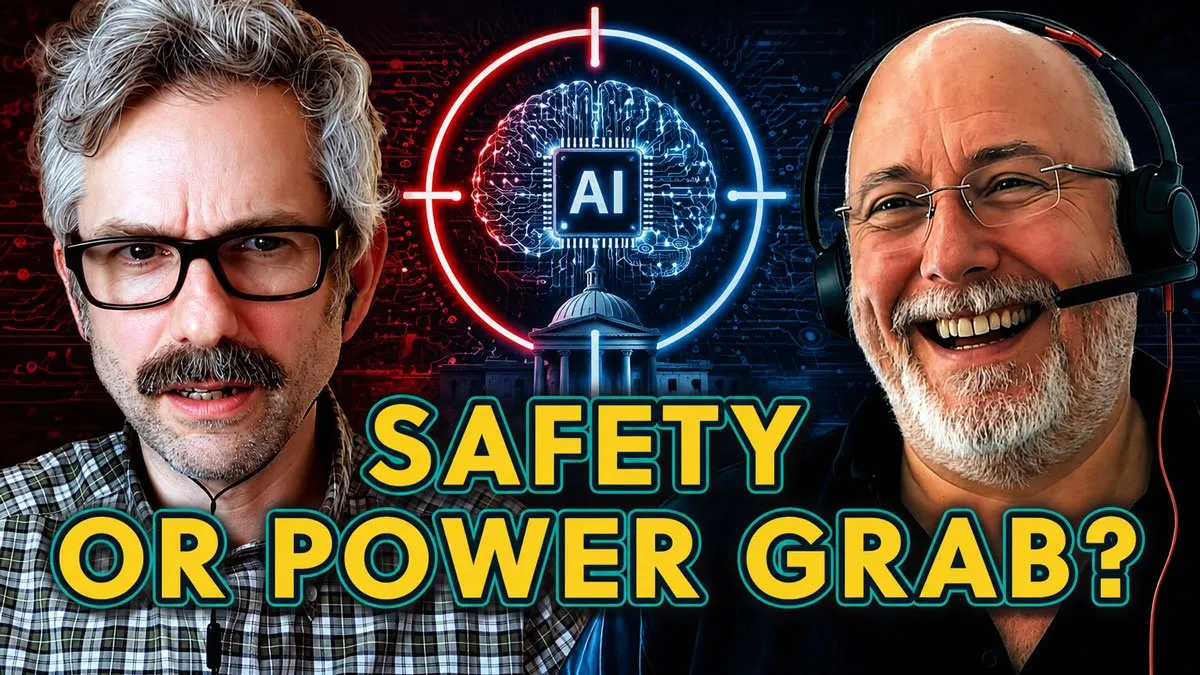
A weekly podcast where an approachable AI doomer and a techno-optimist argue over the latest AI news. Heavy topics, discussed lightly.

Frank Prendergast
The approachable doomer.

Justin Collery
The techno-overoptimist.